

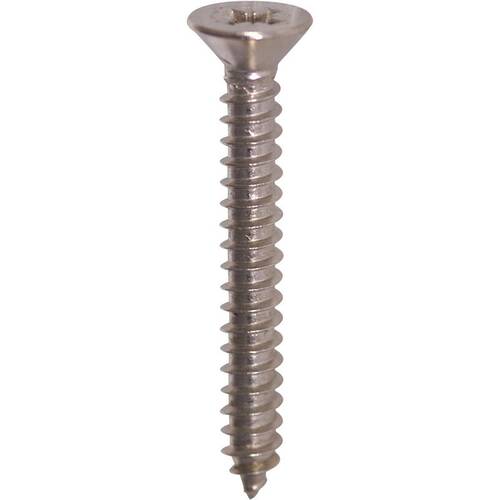
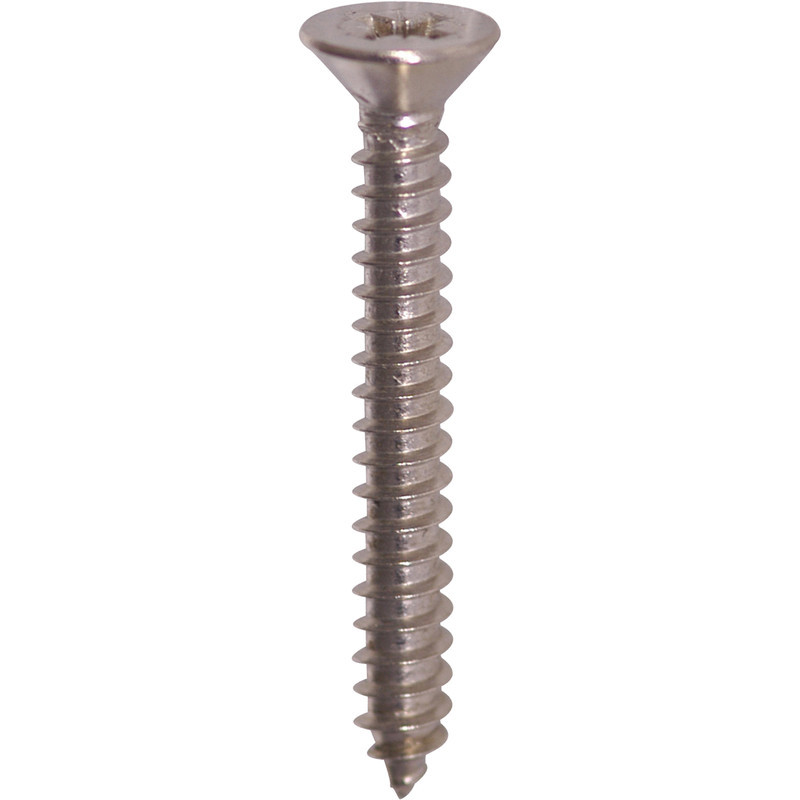
NetcamCenter Screw
NetcamCenter
Article code 3455

 {{ fullProductName }}
Description NetcamCenter Screw
A screw consists of a cylindrical or conical part (the shank) around which a thread is applied, with a widening at one end, the head, in which a slot or a differently shaped recess is made at the end. A screwdriver fits into this.
A screw is tightened with a screwdriver or a screw drill from the top of the head. If the tightening force is applied to the outside of the head, we speak of a bolt.
In Europe and Asia, the dimensions of screws and bolts are usually indicated in the form M(etric)(diameter of the shank in mm) × (length of the shank in mm), for example M5 × 15. The dimensions are thus measured excluding the head (left in the photo). Only with a countersunk screw (right in the photo), where the head is conical on the underside and flat on top, is the head included in the stated length (15 mm). With an M5 × 15 hex socket screw, the cylindrical head can add as much as 5 mm of length to the total.
Screws with a threaded end that has the same diameter along the entire length are turned into nuts or tapped holes; screws with a pointed end are turned directly into the material to be fastened.
Confusion of terms screw and bolt
In common usage, the difference between a screw and a bolt is the difference between a tapering thread and a thread diameter that stays the same along the length of the bolt. The 'correct' definition, however, is that with a bolt the shaft is fitted with a head that is usually hexagonal and with which the bolt can be tightened from the outside (according to NEN 5501). If the ability to tighten is obtained through a recess in the head, it is called a screw. The recess can, for example, be a straight slot, a cross slot, an internal square or hexagon, a six-point star or a twelve-point star. For example: a "nut bolt" and a "wood screw".
The head
The shape of the head can be:
- hexagonal: the underside sits flush against the material to be fastened; a wrench fits on the top with which the screw can be tightened or loosened. Formally, this is not a screw but a bolt.
- round: the underside sits flush against the material to be fastened; the top protrudes above the material like a small bump;
- countersunk: the underside of the head is cone-shaped and fits into a pre-made recess in the material; the top is flat and lies level with or slightly below the material surface.
- cylindrical: the underside sits flush against the material to be fastened; the top protrudes above the material like a small cylinder;
- lens head: conical underside, hemispherical top
- knurled screws have a head with a rough edge that provides enough grip to be turned with the fingers.
- slot with straight and slanted sides: these screws are used in burglary prevention and can only be turned in. If one tries to unscrew the screw, the screwdriver slips over the head. These are therefore called one-way screws or single-turn screws.
- torx: A screw originating from the automotive industry, but nowadays also widely used in construction. A torx head on a screw consists of a star-shaped hole with six points into which the torx key fits.
The slot/drive
Apart from the shape of the head seen from the side, screws can be manufactured for different types of screwdrivers (the letters refer to the image): regular slotted screw (a) for flat screwdriver, cross head: such as Phillips (b) and Pozidriv (often incorrectly written as Pozidrive) (c), Torx (d), Hex socket (e), SD Square drive (f). One-way screws are a special case of regular slotted screws; the "slot" is shaped in such a way that the screw can only be tightened.
Cross-head screws are the most common. Slotted screws are used less and less in industry. Hex socket is also fairly common; here it is essential to use exactly the right size of tightening tool. SD is mostly used for metal screws. The one-way screw is used for security.
At the moment the Torx screw is strongly on the rise, because it has more grip than the Pozidriv. There are also numerous developments in the field of drive types; for instance, there are already manufacturers producing a screw that fits several different drives, such as Pozidriv, SD and Torx. This prevents having to use different types of bits each time.
The thread
The pitch of the thread is the displacement of the thread per one revolution.
The thread can also taper (over the entire length or only at the point), depending on the different applications, for example wood screws, chipboard screws, plasterboard screws, (metal) sheet screws, self-tapping screws. To use a screw in a brick wall, a plug is needed.
Material
Screws can be made from many types of material, plain steel, stainless steel, brass, plastic etc. Screws are sometimes given a treatment, for example hardening to increase wear resistance and strength, or a surface treatment to prevent corrosion or simply to improve the appearance.
Downloads
| Lemur | Download |
Video
Specifications
Product
| Model number | 3455 |
| GTIN code | 333333 |
| Brand | NetcamCenter |
| Category |
Other Products
|
| Country of origin |
Netherlands
|
| Weight |
2 grams
|
| Size (lxwxh) |
7
x 5 x 12 millimeters
|
|
Basic Functionality
|
✓ |
|
Various
|
Others
|
| Date published | 7/18/2019 |