Technical explanation
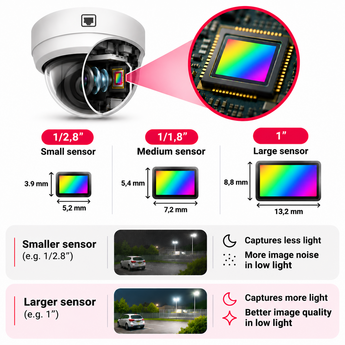
Sensor
An image sensor is the part of a camera that captures light and converts it into an image. The size of the sensor is indicated in inches. The larger the sensor, the more light it can usually capture. CMOS is a technology that allows the camera to capture images quickly and consume little power. RGB means that the camera captures colors using red, green, and blue. Progressive scan ensures that the entire image is built up at once, making moving objects appear clearer.
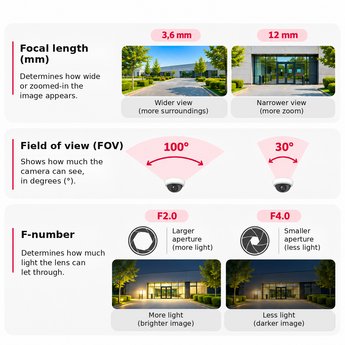
Lens
A camera lens determines how much of the surroundings are visible and how much light enters. The focal length (mm) determines how wide or zoomed in the image is. A lower number of millimeters results in a wider viewing angle, while a higher number provides a narrower, more zoomed-in image. The angle of view (FOV) is indicated in degrees (°) and shows how much the camera can see. The F-number determines how much light the lens can let through. The lower this value, the more light the lens can let through. A higher F-number lets less light through, but in bright daylight can provide greater depth of field, causing objects at different distances to remain sharper in the image.